

What Is The Genetic Makeup Of A Trait Called
Genes come in different varieties, called alleles. Somatic cells contain two alleles for every gene, with one allele provided by each parent of an organism. Often, information technology is impossible to determine which two alleles of a gene are present within an organism'due south chromosomes based solely on the outward appearance of that organism. Notwithstanding, an allele that is hidden, or not expressed by an organism, tin can all the same be passed on to that organism's offspring and expressed in a later generation.
Tracing a subconscious gene through a family tree
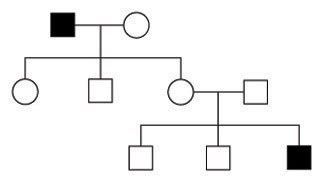
Figure 1: In this family unit full-blooded, black squares signal the presence of a particular trait in a male person, and white squares represent males without the trait. White circles are females. A trait in i generation can exist inherited, just not outwardly credible before two more generations (compare black squares).
The family tree in Figure 1 shows how an allele can disappear or "hide" in i generation and so reemerge in a subsequently generation. In this family tree, the father in the start generation shows a particular trait (as indicated by the blackness square), but none of the children in the second generation show that trait. Withal, the trait reappears in the third generation (black foursquare, lower right). How is this possible? This question is best answered by because the basic principles of inheritance.
Mendel'southward principles of inheritance
Gregor Mendel was the get-go person to draw the way in which traits are passed on from one generation to the next (and sometimes skip generations). Through his breeding experiments with pea plants, Mendel established iii principles of inheritance that described the transmission of genetic traits before genes were fifty-fifty discovered. Mendel'southward insights greatly expanded scientists' understanding of genetic inheritance, and they besides led to the development of new experimental methods.
One of the cardinal conclusions Mendel reached afterward studying and breeding multiple generations of pea plants was the idea that "[you cannot] describe from the external resemblances [whatsoever] conclusions as to [the plants'] internal nature." Today, scientists apply the word "phenotype" to refer to what Mendel termed an organism's "external resemblance," and the word "genotype" to refer to what Mendel termed an organism's "internal nature." Thus, to recapitulate Mendel's conclusion in modernistic terms, an organism's genotype cannot be inferred by but observing its phenotype. Indeed, Mendel'southward experiments revealed that phenotypes could be hidden in i generation, but to reemerge in subsequent generations. Mendel thus wondered how organisms preserved the "elementen" (or hereditary material) associated with these traits in the intervening generation, when the traits were subconscious from view.
How practise hidden genes pass from one generation to the next?
Although an individual gene may code for a specific physical trait, that gene can exist in different forms, or alleles. One allele for every gene in an organism is inherited from each of that organism'due south parents. In some cases, both parents provide the same allele of a given gene, and the offspring is referred to equally homozygous ("homo" meaning "same") for that allele. In other cases, each parent provides a different allele of a given gene, and the offspring is referred to as heterozygous ("hetero" meaning "different") for that allele. Alleles produce phenotypes (or physical versions of a trait) that are either ascendant or recessive. The dominance or recessivity associated with a item allele is the result of masking, by which a dominant phenotype hides a recessive phenotype. By this logic, in heterozygous offspring simply the dominant phenotype will be apparent.
The relationship of alleles to phenotype: an case
Relationships betwixt dominant and recessive phenotypes can be observed with convenance experiments. Gregor Mendel bred generations of pea plants, and as a consequence of his experiments, he was able to advise the thought of allelic gene forms. Modernistic scientists utilize organisms that have faster breeding times than the pea plant, such as the fruit fly (Drosophila melanogaster). Thus, Mendel's primary discoveries volition be described in terms of this modern experimental choice for the remainder of this discussion.

Figure ii: In fruit flies, two possible trunk color phenotypes are dark-brown and black.
The substance that Mendel referred to as "elementen" is at present known as the gene, and different alleles of a given gene are known to requite rise to different traits. For instance, breeding experiments with fruit flies have revealed that a single cistron controls wing torso color, and that a fruit fly tin can accept either a brown body or a blackness trunk. This coloration is a straight consequence of the body colour alleles that a wing inherits from its parents (Figure 2).
In fruit flies, the cistron for torso color has 2 dissimilar alleles: the black allele and the brownish allele. Moreover, brown torso color is the dominant phenotype, and blackness body color is the recessive phenotype.
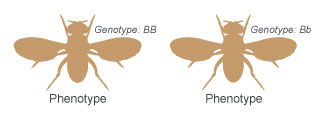
Effigy 3: Unlike genotypes can produce the same phenotype.
Researchers rely on a blazon of autograph to represent the different alleles of a gene. In the case of the fruit fly, the allele that codes for brown body color is represented by a B (because brown is the ascendant phenotype), and the allele that codes for black body color is represented past a b (considering black is the recessive phenotype). Equally previously mentioned, each fly inherits ane allele for the body color gene from each of its parents. Therefore, each wing will carry ii alleles for the body colour cistron. Within an private organism, the specific combination of alleles for a factor is known as the genotype of the organism, and (as mentioned to a higher place) the concrete trait associated with that genotype is called the phenotype of the organism. So, if a fly has the BB or Bb genotype, it will have a brown body colour phenotype (Figure 3). In contrast, if a fly has the bb genotype, it will have a black trunk phenotype.
Potency, breeding experiments, and Punnett squares
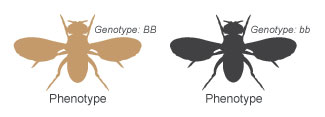
Figure 4: A chocolate-brown fly and a black wing are mated.
The all-time fashion to sympathise the authorization and recessivity of phenotypes is through convenance experiments. Consider, for example, a convenance experiment in which a fruit wing with brownish body color (BB) is mated to a fruit fly with black body color (bb). (The genotypes of these two flies are shown in Figure 4.) The convenance, or cross, performed in this experiment can exist denoted as BB × bb.

Figure v: A Punnett foursquare.
When conducting a cross, one mode of showing the potential combinations of parental alleles in the offspring is to marshal the alleles in a grid called a Punnett square, which functions in a manner similar to a multiplication table (Figure 5).
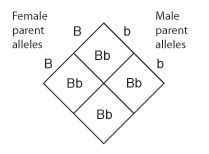
Effigy 6: Each parent contributes one allele to each of its offspring. Thus, in this cross, all offspring will have the Bb genotype.
If the alleles on the exterior of the Punnett square are paired up in each intersecting square in the filigree, it becomes articulate that, in this particular cross, the female person parent can contribute simply the B allele, and the begetter tin can contribute only the b allele. As a result, all of the offspring from this cross volition have the Bb genotype (Figure 6).
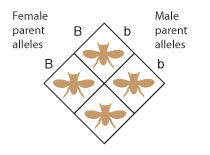
Figure 7: Genotype is translated into phenotype. In this cross, all offspring will have the dark-brown body color phenotype.
If these genotypes are translated into their corresponding phenotypes, all of the offspring from this cantankerous volition accept the brown body color phenotype (Figure 7).
This outcome shows that the brownish allele (B) and its associated phenotype are ascendant to the black allele (b) and its associated phenotype. Even though all of the offspring have brown body color, they are heterozygous for the black allele.
The phenomenon of ascendant phenotypes arising from the allele interactions exhibited in this cross is known as the principle of uniformity, which states that all of the offspring from a cross where the parents differ by only one trait will appear identical.
How can a breeding experiment be used to discover a genotype?

Effigy viii: A Punnett square can help determine the identity of an unknown allele.
Brown flies can be either homozygous (BB) or heterozygous (Bb) - but is information technology possible to determine whether a female wing with a dark-brown body has the genotype BB or Bb? To answer this question, an experiment called a test cross can be performed. Exam crosses help researchers determine the genotype of an organism when just its phenotype (i.due east., its appearance) is known.
A test cross is a convenance experiment in which an organism with an unknown genotype associated with the dominant phenotype is mated to an organism that is homozygous for the recessive phenotype. The Punnett square in Figure 8 can be used to consider how the identity of the unknown allele is determined in a examination cross.
Breeding the flies shown in this Punnett square will determine the distribution of phenotypes among their offspring. If the female parent has the genotype BB, all of the offspring will take brown bodies (Effigy 9, Outcome 1). If the mother has the genotype Bb, 50% of the offspring will accept brown bodies and 50% of the offspring volition have blackness bodies (Effigy 9, Outcome 2). In this manner, the genotype of the unknown parent can exist inferred.

Again, the Punnett squares in this case role like a genetic multiplication table, and in that location is a specific reason why squares such every bit these work. During meiosis, chromosome pairs are dissever autonomously and distributed into cells called gametes. Each gamete contains a single copy of every chromosome, and each chromosome contains 1 allele for every gene. Therefore, each allele for a given gene is packaged into a separate gamete. For example, a fly with the genotype Bb will produce two types of gametes: B and b. In comparing, a fly with the genotype BB will only produce B gametes, and a fly with the genotype bb volition only produce b gametes.

Figure 10: A monohybrid cantankerous betwixt two parents with the Bb genotype.
The following monohybrid cantankerous shows how this concept works. In this type of breeding experiment, each parent is heterozygous for torso colour, and then the cross tin can be represented by the expression Bb × Bb (Figure 10).
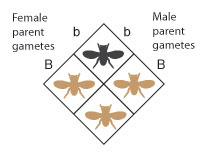
Figure eleven: The phenotypic ratio is iii:1 (chocolate-brown torso: black torso).
The issue of this cross is a phenotypic ratio of 3:i for chocolate-brown torso colour to black body color (Figure 11).
This ascertainment forms the second principle of inheritance, the principle of segregation, which states that the ii alleles for each gene are physically segregated when they are packaged into gametes, and each parent randomly contributes one allele for each factor to its offspring.
Can two different genes be examined at the same time?
The principle of segregation explains how individual alleles are separated among chromosomes. But is it possible to consider how two different genes, each with different allelic forms, are inherited at the same time? For example, can the alleles for the body colour gene (brown and black) exist mixed and matched in dissimilar combinations with the alleles for the eye color cistron (red and brown)?
The uncomplicated answer to this question is yeah. When chromosome pairs randomly align forth the metaphase plate during meiosis I, each member of the chromosome pair contains i allele for every gene. Each gamete will receive one re-create of each chromosome and one allele for every gene. When the individual chromosomes are distributed into gametes, the alleles of the different genes they carry are mixed and matched with respect to one another.
In this example, in that location are two unlike alleles for the heart color factor: the E allele for red eye colour, and the east allele for chocolate-brown heart color. The blood-red (E) phenotype is dominant to the brown (e) phenotype, then heterozygous flies with the genotype Ee will have crimson optics.
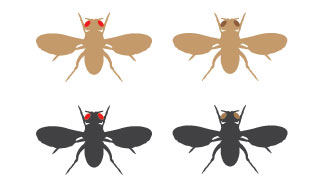
Figure 12: The four phenotypes that tin can event from combining alleles B, b, Eastward, and eastward.
When 2 flies that are heterozygous for chocolate-brown body color and scarlet optics are crossed (BbEe 10 BbEe), their alleles can combine to produce offspring with four different phenotypes (Effigy 12). Those phenotypes are brown body with reddish eyes, brown trunk with brown optics, black body with cherry eyes, and black body with brown optics.
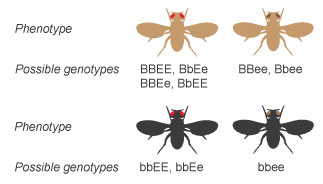
Effigy 13: The possible genotypes for each of the four phenotypes.
Even though only four different phenotypes are possible from this cross, nine different genotypes are possible, every bit shown in Figure xiii.
The dihybrid cross: charting two unlike traits in a unmarried breeding experiment
Consider a cross betwixt two parents that are heterozygous for both trunk color and eye color (BbEe x BbEe). This type of experiment is known as a dihybrid cross. All possible genotypes and associated phenotypes in this kind of cross are shown in Figure xiv.
The four possible phenotypes from this cantankerous occur in the proportions 9:3:3:1. Specifically, this cantankerous yields the following:
- nine flies with brown bodies and red eyes
- 3 flies with brownish bodies and brown eyes
- 3 flies with black bodies and red eyes
- ane fly with a black torso and brown eyes
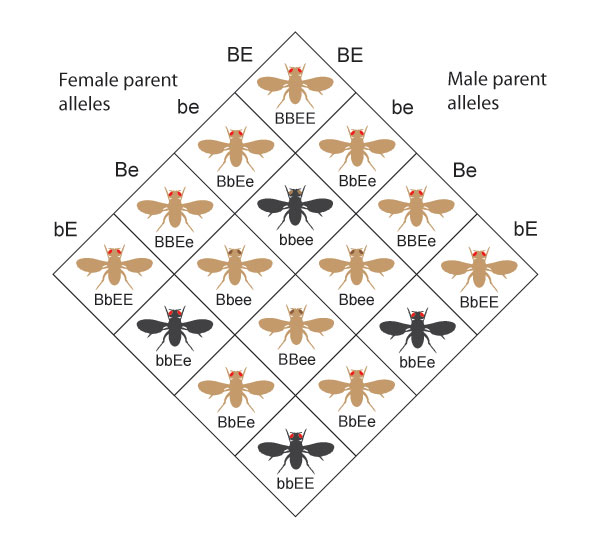
Effigy 14: These are all of the possible genotypes and phenotypes that can result from a dihybrid cross between two BbEe parents.
Why does this ratio of phenotypes occur? To reply this question, it is necessary to consider the proportions of the individual alleles involved in the cross. The ratio of brown-bodied flies to blackness-bodied flies is 3:ane, and the ratio of reddish-eyed flies to brown-eyed flies is too iii:ane. This means that the outcomes of body color and eye color traits appear as if they were derived from 2 parallel monohybrid crosses. In other words, even though alleles of two different genes were involved in this cantankerous, these alleles behaved as if they had segregated independently.
The outcome of a dihybrid cross illustrates the third and final principle of inheritance, the primary of independent assortment, which states that the alleles for ane factor segregate into gametes independently of the alleles for other genes. To restate this principle using the example above, all alleles assort in the aforementioned style whether they lawmaking for body colour alone, heart color alone, or both body color and eye color in the same cross.
The impact of Mendel's principles
Seminal experiments on inheritance
Mendel'due south principles tin can be used to understand how genes and their alleles are passed down from one generation to the next. When visualized with a Punnett square, these principles tin can predict the potential combinations of offspring from two parents of known genotype, or infer an unknown parental genotype from tallying the resultant offspring.
An important question notwithstanding remains: Do all organisms pass on their genes in this mode? The answer to this question is no, simply many organisms practice showroom uncomplicated inheritance patterns similar to those of fruit flies and Mendel's peas. These principles form a model against which different inheritance patterns tin can be compared, and this model provide researchers with a style to analyze deviations from Mendelian principles.
Source: http://www.nature.com/scitable/topicpage/inheritance-of-traits-by-offspring-follows-predictable-6524925
Posted by: mccoywaake1974.blogspot.com
0 Response to "What Is The Genetic Makeup Of A Trait Called"
Post a Comment