

What Is The Manba Makeup Trend
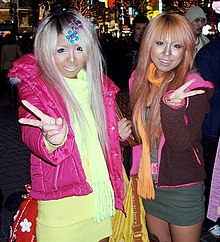
2 ganguro girls in Tokyo, April 2008
Ganguro (Japanese: ガングロ) is a fashion tendency amid young Japanese women that started in the mid-1990s, distinguished by a dark tan and contrasting make-upward liberally applied by fashionistas.
The Shibuya and Ikebukuro districts of Tokyo were the centres of ganguro fashion; it was started by rebellious youth who contradicted the traditional Japanese concept of beauty; pale skin, dark hair and neutral makeup tones. Ganguro instead tanned their skin, bleached their hair and used much colourful makeup in unusual ways.[1]
Ganguro has a connection to Japanese folklore of ghosts and demons who are depicted with a similar advent such as those in kabuki and noh costumes. This connection is further underlined by the off-shoot style yamanba, named after a mountain witch in Japanese sociology.[two]
The ganguro trend started in the mid-1990s and reached its peak by the latter one-half of the decade; information technology purportedly became almost obsolete by 2000 when a bihaku (light peel) craze emerged amidst immature women who wanted to imitate the await of their favourite popular singers,[three] specifically Ayumi Hamasaki,[4] who debuted at the time. The ganguro tendency faded out afterwards, although its influence can be observed in yamanba and manba styles.[v]
Characteristics [edit]
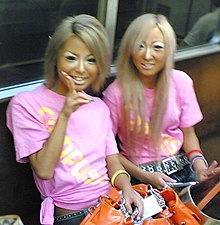
2 Japanese ganguro girls in the subway, August 2006

Ganguro style and a school compatible in Shinjuku, September 2015
Ganguro appeared as a new fashion style in Japan in the early 1990s and was prevalent generally amidst immature women. In ganguro fashion, a deep tan is combined with pilus dyed in shades of red to blonde, or a silver grayness known as "loftier bleached". Black ink is used as eyeliner and white concealer is used as lipstick and eyeshadow. False eyelashes, plastic facial gems, and pearl powder are ofttimes added to this. Platform shoes and brightly coloured outfits consummate the ganguro wait. Besides typical of ganguro fashion are necktie-dyed sarongs, miniskirts, stickers on the face, and many bracelets, rings, and necklaces.[2]
Ganguro falls into the larger subculture of gyaru ( ギャル , from English language "gal"), a slang term used for various groups of immature women, usually referring to overly childish women. Researchers in the field of Japanese studies believe that ganguro is a form of revenge against traditional Japanese society due to resentment of neglect, isolation, and constraint of Japanese society. This is their attempt at individuality, self-expression, and freedom, in open defiance of schoolhouse standards and regulations.[ commendation needed ]
Ganguro tin can exist used to describe girls, or gals, with a tan, lightened hair and some brand article of clothing; they can often exist confused with Oneegyaru (Large Sister Gal) and Serebu (Celeb), although Oneegyaru is usually associated with expensive gal brands and Serebu focuses on expensive western fashions.
Fashion magazines like Egg and Ageha have had a direct influence on the ganguro. Other pop ganguro magazines include Popteen and Ego Organisation. The ganguro civilisation is oftentimes linked with para para, a Japanese dance style. However, most para para dancers are not ganguro, and most ganguro are not para para dancers, though in that location are many who are ganguro or gal and dance para para.
Ane of the nigh famous early ganguro girls was known every bit Buriteri, nicknamed subsequently the black soy sauce used to flavour yellowtail fish in teriyaki cooking. Egg made her a star by oftentimes featuring her in its pages during the height of the ganguro craze. Subsequently modelling and advertising for the Shibuya tanning salon "Blacky", social pressure and negative press convinced Buriteri to retire from the ganguro lifestyle.[6]
Yamanba and Manba [edit]

Manba, 2006

Yamanba, 2016
Yamanba ( ヤマンバ ) and manba ( マンバ ) are styles which adult from ganguro. Quondam school yamanba and manba (particularly known as 2004 Manba) featured night tans and white lipstick, pastel eye makeup, tiny metallic or glittery adhesives below the eyes, brightly coloured circumvolve lenses, plastic dayglo-coloured clothing, and incongruous accessories, such as Hawaiian leis. Stickers on the face died out shortly after 2004 and, for a while, yamanba died. Manba then became more than extreme, with multicoloured and unremarkably synthetic pilus. Manba in 2008 saw a darker tan, and no facial stickers. Hair was unremarkably neon/vivid colours, with pink being a favourite. Wool emulating dreadlocks, extensions, and clips were worn to make pilus announced longer. Habiliment remained the same, although leis were worn less oftentimes.[two]
Yamanba and manba are distinct from one some other. Yamanba involves white make-upwards simply above the eye, while manba makeup is practical below the eye too.[ citation needed ] Stuffed animals, bracelets, bells and hibiscus flowers are worn.[ citation needed ] The male person equivalent is called a "Heart guy",[ commendation needed ] a pun on the proper noun of a popular pedestrian shopping street near Shibuya Station in Tokyo called Center Gai ( センター街 , Sentā-gai ).
Etymology [edit]
Ganguro practitioners say that the term derives from the phrase ganganguro or gangankuro ( ガンガン黒 , exceptionally dark). The word ganguro can be translated as "burn-black look", and "dark tanning".[vii]
The term yamanba is derived from Yama-uba, the proper noun of a mountain hag in Japanese sociology whom the way is thought to resemble.
See likewise [edit]
- AV idol
- Burusera
- Cosplay restaurant
- Gals!
- Gyaru
- Host and hostess clubs
- JK business
- Kawaii
- Kogal
- Maid café
- Panchira
- Peach Daughter
- Zettai ryōiki
- Sun tanning
References [edit]
- ^ Nicole Mowbray (2004-04-04). "Japanese girls cull whiter shade of stake | World news | The Observer". Guardian. London. Retrieved 2011-07-11 .
- ^ a b c "提言論文 かわいいマンバ - ガングロII・2004(2004年) - J-marketing.internet produced past JMR生活総合研究所". Jmrlsi.co.jp. Retrieved 2011-07-eleven .
- ^ "ガングロ|流行語や歴史に役立つ情報サイト【あの頃は何が流行ったの?】". Ryuukou-maro.net. Archived from the original on 2014-02-22. Retrieved 2014-02-12 .
- ^ 姫島, 貴人 (2001). ロードガイア. 文芸社. ISBN4835511018.
- ^ "ガングロはどこへいった - リアルライブ". Npn.co.jp. Retrieved 2014-02-12 .
- ^ Macias, Patrick; Evers, Izumi (2007). Japanese Schoolgirl Inferno: Tokyo Teen Way Subculture Handbook. San Francisco: Chronicle Books. p. 66. ISBN978-0-8118-5690-4.
- ^ https://www.weblio.jp/content/%E3%82%Air conditioning%E3%83%B3%E3%82%B0%E3%83%Ad
External links [edit]
- The Ganguro Effect
- "British followers of Japanese fashion"—BBC World Service article
Source: https://en.wikipedia.org/wiki/Ganguro
Posted by: mccoywaake1974.blogspot.com
0 Response to "What Is The Manba Makeup Trend"
Post a Comment